She's Taking a Harvard Cooking Course to Fix Her AI Model
May 27, 2026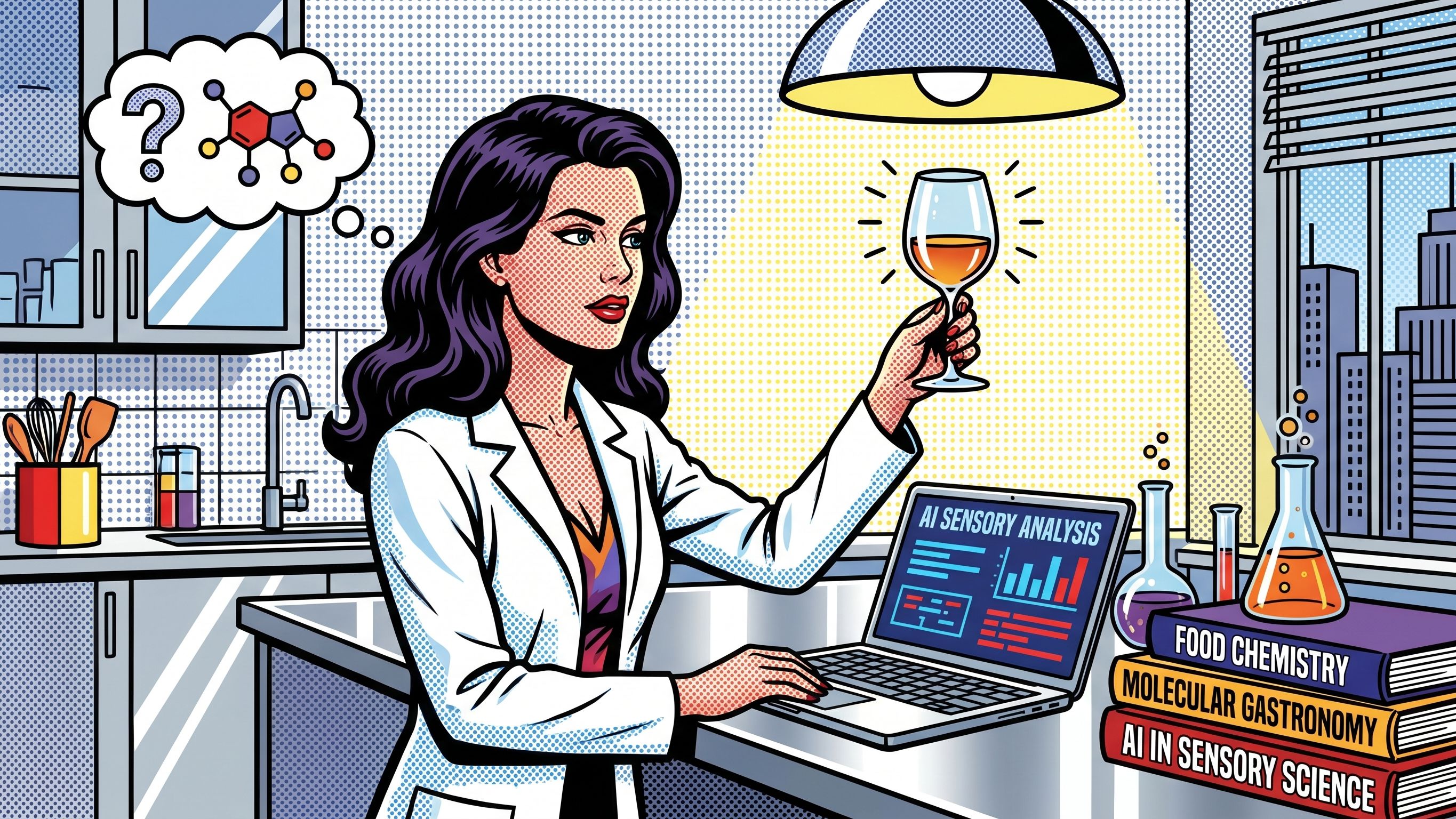
She’s Taking a Harvard Cooking Course to Fix Her AI Model
When your AI keeps hallucinating about wine pairings, you don’t hire a consultant. You learn food chemistry yourself.
Natalie Moore is reading a book called Flavorama. It’s about the science of flavor perception — how tannins interact with proteins, how acid shifts sweetness, how aroma compounds behave at different temperatures.
She’s not reading it for fun. She’s reading it to feed her AI model.
Natalie is the founder of Tailored Tannins, a wine-pairing AI app. Before that, she was a product and business leader at Integra Beauty, where she grew annual revenue by $40M. She knows how to build a business. She knows how to lead teams. And right now, she is personally building the machine learning model at the center of her product — enrolling in Harvard’s Science and Cooking course and a Columbia applied ML certification to do it right.
“The secret sauce behind Tailored Tannins will be this data model that I’m slowly starting to kind of build on my own.”
Why she won’t outsource the hard part
The problem Natalie is solving is specific and stubborn: wine-pairing recommendations that hallucinate. An AI might confidently suggest a bold Cabernet with delicate sashimi. It sounds plausible. It’s wrong. And if your whole product is built on pairing accuracy, “plausible but wrong” is a death sentence.
Most founders would hire a data scientist. Natalie enrolled in a cooking course at Harvard instead.
That sounds eccentric until you understand the logic. Her model hallucinates because it lacks domain knowledge about how flavors actually work together at a chemical level. You can’t fix that with better prompts or more training data scraped from wine blogs. You fix it by understanding, personally, why a high-tannin red overwhelms a light fish dish. Then you encode that understanding into the model’s architecture.
She’s also conducting blind taste tests herself to validate the model’s outputs. Not outsourcing validation to a panel. Sitting down, tasting, comparing what the model recommends against what actually works on the palate. Building ground truth one pairing at a time.
The prototype that changed every conversation
While building the model, Natalie also built a clickable prototype of Tailored Tannins using GenAI tools. Then she started showing it to culinary institutes.
“Having like a clickable prototype as I’ve been chatting with all these different culinary institutes — it unlocks discoveries.”
Before the prototype, she was pitching verbally. Describing the vision, explaining the technology, hoping people could see what she saw. The conversations were fine. They weren’t productive.
The prototype changed that. People could tap through screens, react to real flows, point at things that confused them or excited them. Culinary experts started volunteering insights Natalie hadn’t anticipated. Partnerships materialized that wouldn’t have emerged from a slide deck.
“Visually articulating what you’re trying to achieve is a lot easier for people to understand than just talking about it.”
This is the AI player-coach instinct at work. You don’t describe the future. You build a version of it — however rough — and put it in front of people who can make it better.
What this kind of obsession actually looks like
Take a step back and look at what Natalie is doing simultaneously: building an ML model, studying food chemistry at Harvard, earning an applied ML certification from Columbia, conducting blind taste tests, reading Flavorama, and showing a self-built prototype to culinary institutes across the country.
Nobody asked her to do any of this. No investor required it. No co-founder is pushing her. She’s doing it because she refuses to lead a product she doesn’t understand at the molecular level.
That’s the player-coach pattern taken to its logical extreme. You can delegate the work, but you can’t delegate the understanding. And for Natalie, “understanding” means knowing why tannins interact with proteins the way they do, so her model stops guessing and starts knowing.
Most leaders I talk to on The AI Product Leader podcast are closing this gap in smaller ways. They prototype a workflow. They learn to prompt effectively. They evaluate tools firsthand. Natalie is doing the same thing — she just happens to be doing it with a Harvard cooking course and a wine glass.
The principle is identical: you can’t lead what you don’t deeply understand. Even when “understanding” means learning how flavor molecules behave at 160 degrees.
Polly Allen is the founder of AI Career Boost and host of The AI Product Leader podcast. She led the first generative AI answers on Amazon Alexa in 2020, before ChatGPT made any of it mainstream, and built the AI Career Boost Blueprint — an 8-week program for product leaders from Staff and Senior Manager to CPO, becoming indispensable AI player-coaches. Subscribe to The AI Player-Coach newsletter → · Join the next live masterclass →