The PM Who Ships After Midnight
May 27, 2026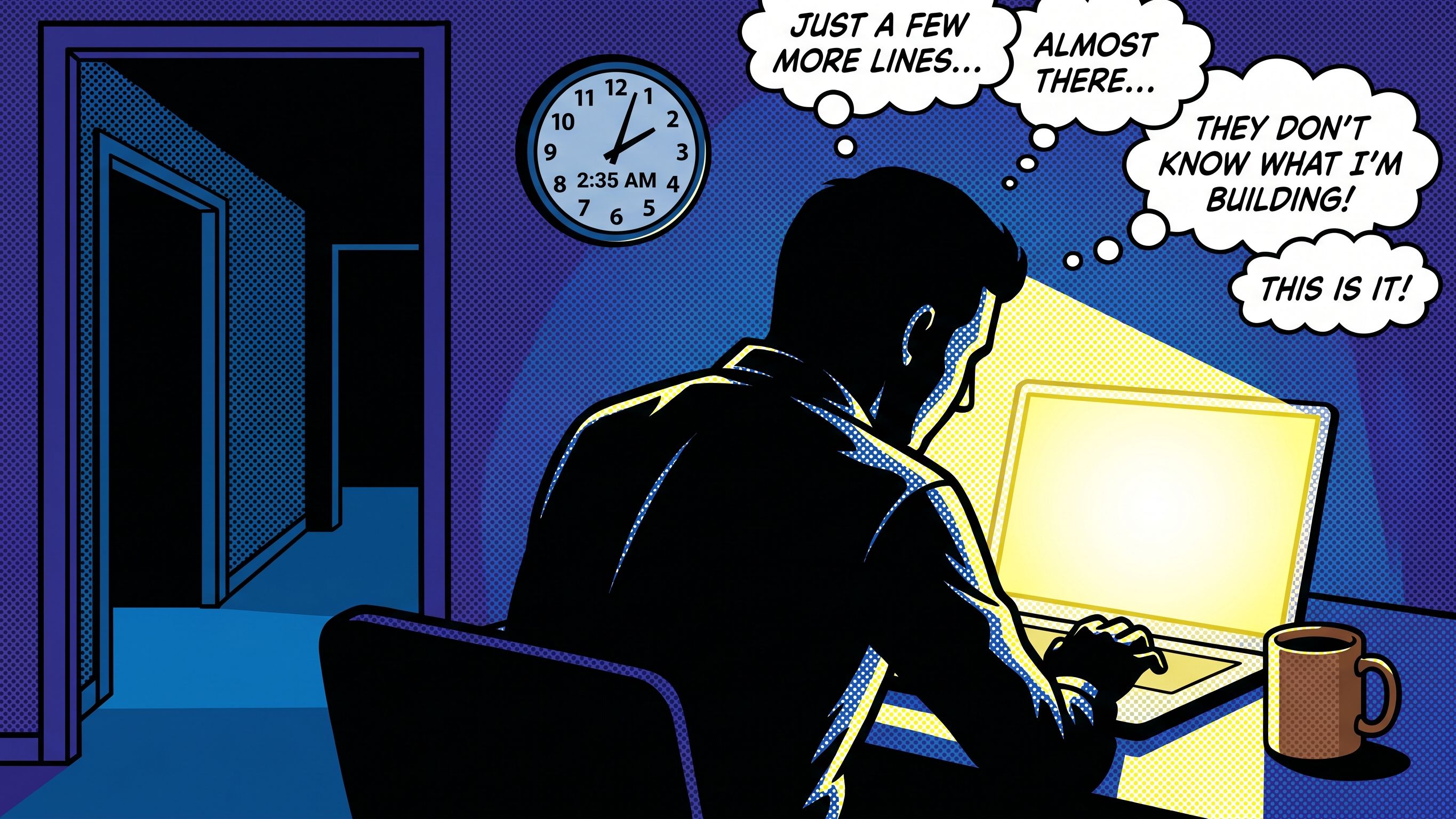
The PM Who Ships After Midnight
What happens when a product manager stops waiting for engineers and starts building himself.
The kids are asleep. The house is dark. It’s 11:30 PM on a Tuesday and Dave Stys is staring at a Cursor window, trying to get an Unsplash integration working inside an MCP server he probably shouldn’t be touching.
Nobody asked him to do this.
Dave is a product manager at Aweber, working across two teams on an AI-powered email product. He has a full plate during business hours. But he keeps coming back to the screen after bedtime because he can feel something compounding. Every prototype he finishes teaches him something that makes the next conversation at work sharper, the next product decision faster, the next demo more concrete.
“I get asked a lot of times — hey, you’ve got your product management job, you’re working on two teams… where do you find the time? Sometimes I’m investing that time at work during a project. Other times I put the kids to bed and I’m up till midnight.”
Every ambitious leader knows this tension. The pull between “I should sleep” and “I need to know if this works.” It’s not discipline. It’s something closer to compulsion, the kind that shows up when you realize the investment is paying off faster than you expected.
How a PM shipped a feature
Dave didn’t start by asking permission. He noticed his team had an MCP server, looked at how it worked, and realized he could add a tool himself. So he did. He wired up Unsplash and Lumi image search so their AI-generated emails could pull in real photos instead of placeholder graphics.
“I started learning about MCP servers — we had one and I learned it was pretty easy for me to add a tool. So I added a tool… And all of a sudden now we’ve got images in the email.”
He demoed it at Aweber’s internal demo day. The next sprint, an engineer picked up his code and started building on it. A product manager had written the first working version of a feature that shipped.
That sequence matters. Dave didn’t replace an engineer. He removed the ambiguity. Instead of writing a spec that described what image integration could look like, he showed what it did look like. The engineer who picked it up next didn’t have to interpret a requirements doc. They had working code and a clear direction.
This is the AI player-coach pattern in its purest form. A senior IC who builds enough to set the terms of the conversation, then hands the work to the team with context no document could provide.
The weekend app
The MCP integration wasn’t a one-off. Dave built a full walk-up music app for his daughter’s softball team over a single weekend. Web app, Spotify and Apple Music API integration, an Apple Watch app, an iPhone widget. A complete product, start to finish, built by a PM who codes after hours in Cursor.
He’s honest about the learning curve. One of his hard-won lessons: use version control. “I had to remind myself of this. I was losing like a week of work before.” The tools are powerful enough that a PM can build production-quality software, but the fundamentals still bite you when you skip them.
Competition as culture
The most telling detail from Dave’s story isn’t the MCP server or the softball app. It’s what happened to the culture around him.
“Be competitive. There’s a couple of us at work and we get mad if somebody else did the prototype before you did and sometimes we’re working on the same thing secretly.”
That sentence describes a team where prototyping has become a sport. Nobody mandated it. Nobody created an “innovation initiative.” A few people started building, started demoing, started one-upping each other. The competitive energy became self-sustaining.
This is what happens when product managers stop treating AI as someone else’s job. The gap between “I have an idea” and “I built a version” collapses. And once a few people on a team close that gap, nobody wants to be the one still writing specs while their teammates are shipping demos.
The midnight investment
Dave frames his after-hours building as an investment, and the framing matters. He’s not burning out. He’s not performing hustle culture. He’s making a calculated bet that the hours he spends learning Cursor and MCP servers now will compound into career capital that separates him from every PM who’s still waiting for an engineer to validate their ideas.
The midnight session isn’t sustainable forever. It doesn’t have to be. It’s the period of intense practice that builds the muscle memory, the pattern recognition, the technical intuition that turns a product manager into someone who can walk into a room and change the conversation with a working prototype.
Not every leader will stay up past midnight. But every leader needs to find their version of Dave’s investment. The time nobody asked you to spend. The prototype nobody assigned. The skill you’re building because you can feel it mattering, even before anyone else notices.
Polly Allen is the founder of AI Career Boost and host of The AI Product Leader podcast. She led the first generative AI answers on Amazon Alexa in 2020, before ChatGPT made any of it mainstream, and built the AI Career Boost Blueprint — an 8-week program for product leaders from Staff and Senior Manager to CPO, becoming indispensable AI player-coaches. Subscribe to The AI Player-Coach newsletter → · Join the next live masterclass →