What an AI-First Company Actually Looks Like, From a Product Leader Inside One
Aug 23, 2026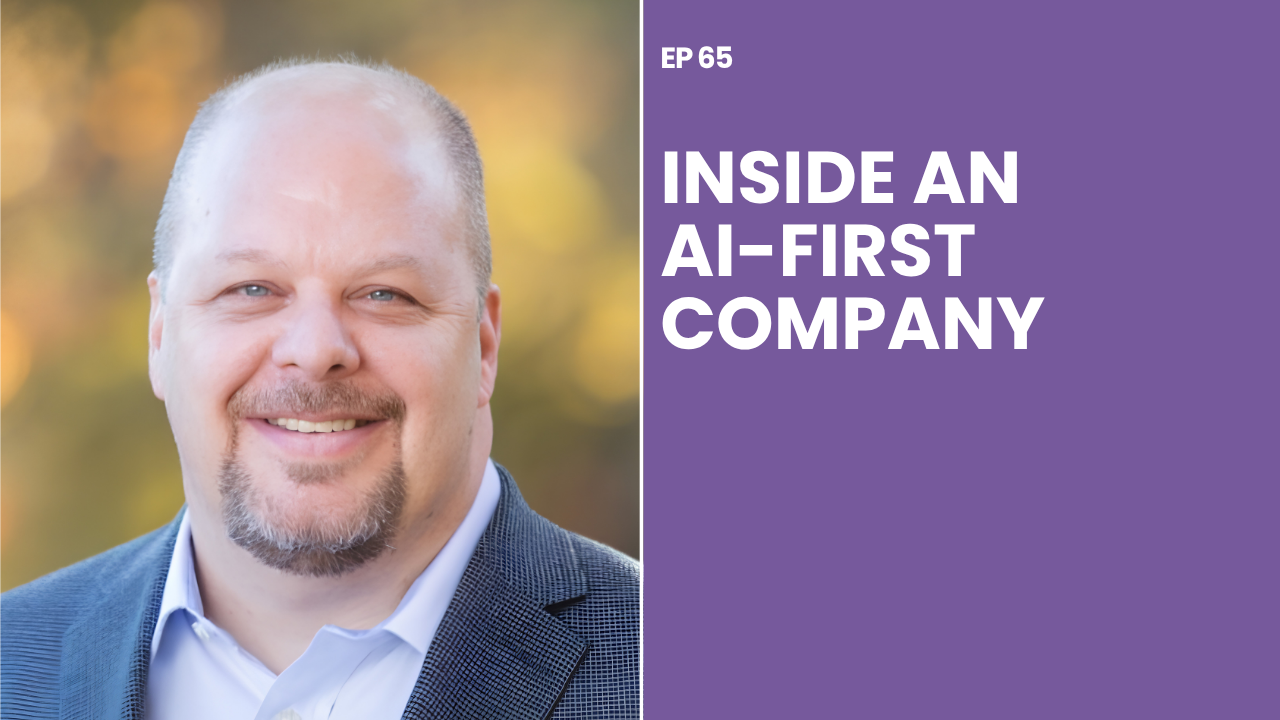
Every product leader has now heard that they should be working at, or building, an "AI-first company". Almost nobody can tell you how you, or that company, operate on an average Tuesday morning.
Jeff Williams can. He's a staff product manager at Open Loop Health, an AI-first company in the truest sense, and he arrived there after twenty-five years in software - with no work history in AI before Open Loop at all.
That gap is where his story starts:
"I got to a point where I didn't have any AI experience and I was missing that and it was a realization that either get it or maybe find something else to do... That was kind of the crossroads I was staring at."
How does his day look today, and how did he prepare to be able to dive in? Let's start with how daily work life is different in an AI-first company.
In an AI-first company, AI use is expected of every function, including sales, customer success, and implementation. At Open Loop Health that means a daily working meeting where problems get solved live on a shared screen, a Claude license for everyone with no scrutiny of token spend, and a shared library where one person’s skill becomes available to all.
Getting hands-on starts with the CEO, and it isn't a slogan
The thing Jeff names first is that the pressure comes from the top and applies to everyone.
"The CEO is, in a great way, challenging everyone in the company to find ways to leverage AI to go faster, be more efficient, and solve problems quicker. And when I mean everyone, I mean everyone. Not just product engineering. Customer success, implementation team. It doesn't matter, even sales."
What makes that more than a memo is the working meeting. There's a large daily one, attended by a co-founder, where people bring problems and the group solves them in the room.
"Literally people are pulling up Claude, live, and sharing screens and we're solving those problems. It's not just here's how I'd recommend doing it. It is actually doing it in that meeting."
Jeff describes teams discovering that another team had been doing something manually for days at a time, work that could run in minutes.
"It was really interesting to see people's eyes just light up like, my god, I didn't know that was even possible."
That's the part most companies skip. They buy licenses and run training. They don't create a recurring, senior-attended forum where the work happens in front of everyone, which is the only thing that reliably transfers a practice from one team to another.
What his actual day looks like
Asked how he uses AI, Jeff said it would be easier to describe where he doesn't. Specifically:
- Research and discovery, including on weekends when it's quiet, with results shared to a common area so colleagues don't repeat the same prompts.
- Background processes monitoring Slack channels to surface what he was tagged in and what's genuinely high priority, so he starts the day with a triage rather than a scroll.
- Direct connections to his product repos, so questions that would have gone to an engineer get answered from the source instead.
- Jira tickets, stories, and epics. In his words: "I rarely touch any of that by hand." A planning meeting's output flows into Jira and Confluence, updating requirements and notifying people.
The connective tissue is MCP into Jira, Notion, and Linear. His manager's standing challenge is to connect it to everything, to the point that weekly status updates to leadership should be generated rather than written.
Then he described the inverse of the same communication challenge:
"Even reversing that to set it up so that people can query my AI to ask it questions about my product, certain statuses, where things are at, and have it answer those without having to bother me. That's the goal."
Two habits worth stealing
Research the person you're reporting to. A colleague challenged Jeff to use Claude to learn how each leader prefers to receive information, then feed that in.
"What is their style? How do they like to receive communication? Do they like it verbose or succinct? What's the tone? So to feed that into it to help my LLM understand when you provide an update, who's the audience, and tone it and style it to them."
More detail for person X, less for person Y, automatically. That's an old political skill made cheap.
Ask for one percent. His manager challenges his own AI, daily, to find ways to make him one percent better, drawing on everything it knows about him from every connected source. It's a small prompt with a compounding shape, and it's the kind of thing that only occurs to you once you've stopped treating the tool as a search box.
Two more details that say a lot about the culture. Everyone has a Claude license, and Jeff has never been questioned about token usage. And when someone builds a skill, it goes into a shared area for everyone.
"No one's building this and hiding it away in the corner. We actively share everything."
The part nobody puts in the job ad
Are there challenges in this new high-performance, high-visibility work culture? Absolutely.
"It's not a hand-holding company. You're expected to learn and get better. I've seen people that come into the company that don't have a whole lot of, or zero, AI experience. And it's tough. It's a tough bridge to make."
People are arriving at companies like this without the groundwork and struggling. Not because they aren't capable, but because the environment assumes a baseline and moves fast.
What made the difference for Jeff was having built something - using AI to build a product with AI features, end-to-end.
"It wasn't something I just read and I could rattle off. I could tap into the time spent in your program and what I produced and how I use it, even though it wasn't necessarily in my career, it didn't matter."
His capstone project for our Blueprint program was a shopping list app that organizes your list by where things sit in the store. He hit the wall every real builder hits: aisle layouts differ store to store and that data is hard to get, so he pivoted to organizing by product category. Then he integrated a Kroger sandbox API to surface deals against items on the list. He built a classifier that, in his words, didn't work very well - which he counts as part of the value. Learning and having war stories to dive into in interviews is the win - not a perfectly-working system.
"I could go deep into the solution that I built. Issues that I ran into, blockers I ran into, maybe pivots I had to make."
The player-coach question
The million-dollar question: a staff product manager is supposed to be doing strategy, thinking about the three-year plan. Is it really a good use of that seniority to be building your own tooling?
"Incredibly, incredibly important. I don't know how people are doing it without it and making that work."
He built himself a skill that scans the noise and tells him what needs attention in the next thirty to sixty minutes. He refines it as it drifts. That's not a junior task he should have delegated. It's the thing that lets him operate at his level in an environment moving at that speed.
That's the whole player-coach argument in one example. The hands-on work is what makes the leadership work possible.
Where to start
If you're staring at the same crossroads Jeff described, build one thing, even badly, end to end, and pay attention to what breaks.
That's what gives you something to say when someone asks what your AI experience actually is.
If you want help working out what to build and what gaps to close first, that's what I run the masterclass for. We build, live, an audit of your own skills and experience against what employers are asking for right now.
Listen to the full conversation: Ep 65, What Working at an AI-First Company Really Looks Like, with Jeff Williams — YouTube · Apple Podcasts · Spotify
Jeff is on LinkedIn, and would genuinely like to hear how you're using AI in your role.
And for more stories of product-coach leaders and AI-first companies from the trenches, drop AI Career Boost a follow on YouTube.
Frequently asked questions
What is an AI-first company?
AI use is expected of every function rather than concentrated in product and engineering. The practical markers are a recurring working meeting where the work happens in front of everyone, tool access for the whole company, and internal tooling that gets shared rather than hoarded.
How does a product manager use AI day to day at an AI-first company?
Jeff Williams runs research and discovery, background processes that monitor Slack and surface what is genuinely high priority, direct connections into his product repos, and Jira tickets, stories, and epics that he rarely writes by hand.
What happens to people who join an AI-first company without AI experience?
Jeff Williams calls it a tough bridge to make. The company expects people to learn without hand-holding, and those who arrive without groundwork struggle, because the environment assumes a baseline and moves fast.
Should senior product leaders build their own tooling?
Jeff Williams calls it incredibly important. He built a skill that scans the noise and tells him what needs attention in the next thirty to sixty minutes, which is what lets him operate at his level in a fast-moving environment.
Polly Allen is the founder of AI Career Boost and host of The AI Product Leader podcast. She led the first generative AI answers on Amazon Alexa in 2020, before ChatGPT made any of it mainstream, and built the AI Career Boost Blueprint — an 8-week program for product leaders from Staff and Senior Manager to CPO, becoming indispensable AI player-coaches. Subscribe to The AI Player-Coach newsletter → · Join the next live masterclass →